Nvidia Blackwell Chips Reportedly Found in China
Nvidia Blackwell Chips Reportedly Found in China Despite Export Controls
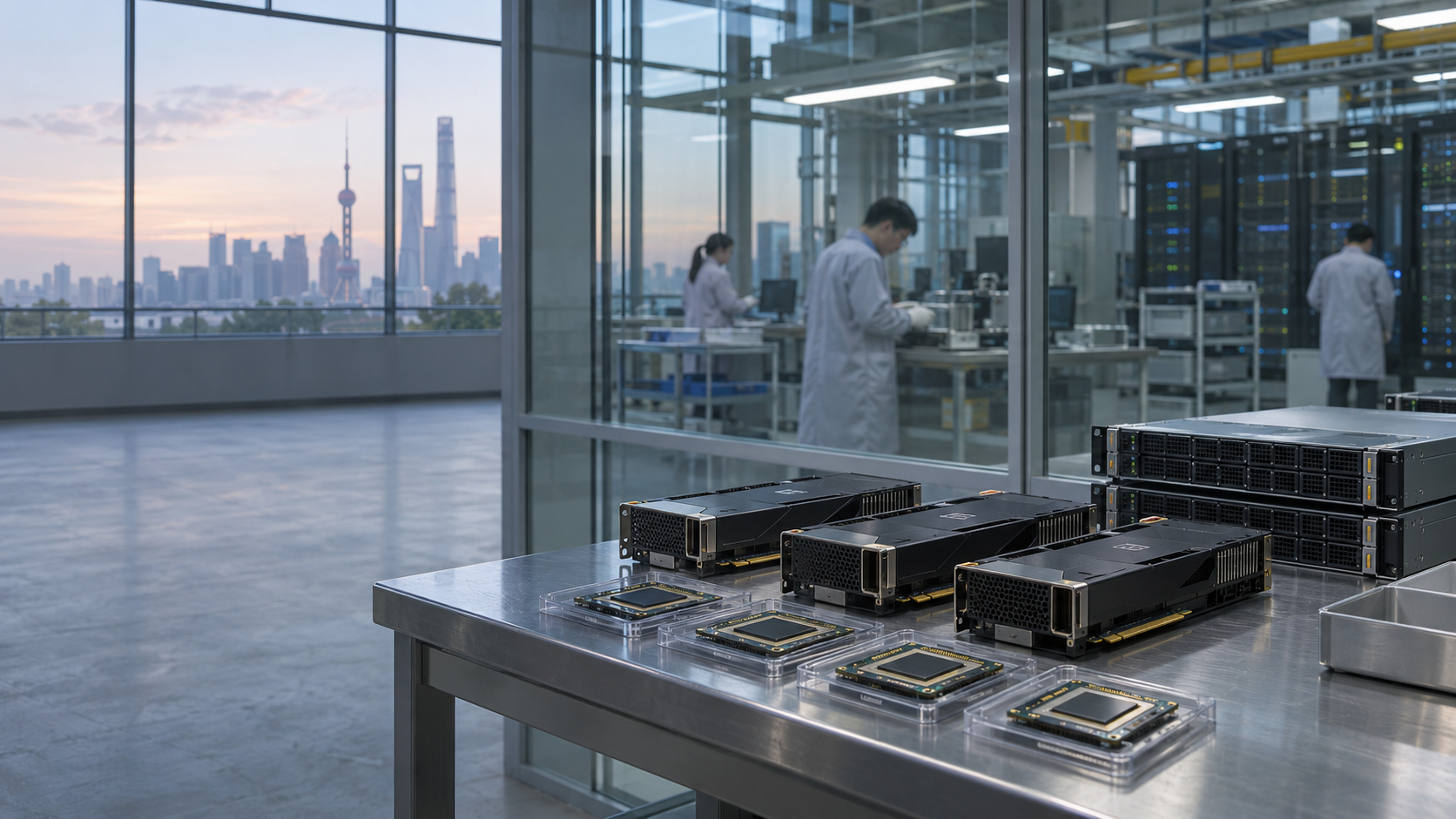
Reports that Nvidia Blackwell hardware appeared at a China-based data center have raised questions about export controls, supply chains, and Nvidia’s China strategy. The reports describe Blackwell chips or other restricted Nvidia hardware at a facility linked to Alice Huang, with one account identifying Shanghai as the location. Source 1 Source 5 Source 7
The reports do not establish that Nvidia shipped the systems directly to China, that the equipment entered the country illegally, or that any law was violated. The central issue is traceability: what hardware was found, when it arrived, who purchased it, how it was shipped, and who controlled access to it?
What the Reports Say
Several supplied reports describe Nvidia Blackwell chips or other restricted Nvidia hardware at a China-based data center reportedly linked to Alice Huang. The summaries do not establish whether Huang owns the facility, operates it, represents a customer, or has another connection to the site. That reported association should not be treated as proof of ownership, control, or wrongdoing.
One report identified Shanghai and contrasted the alleged presence of a Blackwell rack with Jensen Huang’s comments about the physical size of complete Blackwell systems. However, the available material does not clarify whether the site contained a complete rack, individual servers, smaller systems, or separate components assembled on-site.
The reports do not provide customs records, commercial invoices, export licenses, serial-number analysis, or official enforcement findings. They therefore describe an apparent physical presence, not a proven illegal transfer.
Why the Hardware Description Matters
The term “Blackwell chips” can refer to several different parts of Nvidia’s platform, including:
- Individual GPU packages
- GPU boards
- Multi-GPU servers
- Networked server systems
- Integrated racks
- Larger data-center deployments
These categories have different logistical and legal implications. A complete rack requires power distribution, cooling, networking, floor space, maintenance, and management systems. It would be difficult to conceal in personal luggage, but large commercial shipments routinely move through ports, warehouses, distributors, and data centers.
Huang’s reported “too big to smuggle” comment concerns the practicality of moving a complete rack. It does not establish that every Blackwell-related component is impossible to transport discreetly or through ordinary commercial logistics. The exact product must be independently verified through labels, serial numbers, system architecture, installation records, and operating status.
How Could Restricted Hardware Reach China?
Several explanations are possible, although none is established by the supplied reports.
Earlier Authorized Shipment
The equipment may have been sold or shipped before a relevant restriction took effect, or delivered under an existing authorization and installed later. Establishing this would require shipment dates, license records, end-user documents, and installation records.
Indirect Shipment
Equipment can move through manufacturers, distributors, systems integrators, resellers, logistics companies, and data-center operators. Transshipment alone does not prove illegal conduct. Authorities would need to determine whether the declared destination was false, the end user was misrepresented, or the final destination violated applicable rules.
Disassembled or Reconfigured Systems
Servers, networking equipment, power components, and other parts may move through separate channels before being assembled at a facility. This possibility does not prove that the reported hardware arrived that way, but it explains why the size of a complete rack does not resolve every enforcement question.
Gray-Market Resale
High-demand AI hardware can attract brokers and secondary-market sellers. Gray-market activity is not automatically the same as smuggling or an export-control violation. The legal outcome depends on the parties, destination, documentation, transaction structure, and applicable restrictions.
Misidentification
The equipment could be a different Nvidia product, a smaller Blackwell-related system, an incomplete installation, a demonstration unit, or hardware associated with Blackwell but not a complete Blackwell deployment.
Why the Discovery Matters for Export Controls
U.S. export controls seek to limit access to high-performance computing hardware that could support advanced artificial intelligence and other sensitive applications. The rules may consider product performance, destination, end user, end use, and transaction structure. The supplied reports do not identify the specific rule, license, or product classification involved, so they do not establish that every Blackwell product is categorically prohibited in China.
The policy concern extends beyond border entry. Regulators may ask:
- Who owns or controls the machines?
- Which customers can access them?
- Are the systems connected to cloud services?
- What models can be trained?
- Is a restricted entity using the capacity?
- Does a foreign operator control the equipment for Chinese customers?
Authorities examining the installation could seek export licenses, customs declarations, invoices, end-user certificates, shipping records, distributor contracts, installation agreements, serial-number records, access logs, and cloud-service usage records.
Potential Impact on Nvidia
The reported appearance of restricted hardware could increase scrutiny of Nvidia’s customer verification, distributor oversight, resale controls, installation support, product availability, and China strategy. The reports do not establish that Nvidia directly shipped the equipment or authorized its installation. Any corporate responsibility would require evidence of Nvidia’s involvement in the transaction.
Stronger enforcement could lead to tighter licensing requirements, delayed approvals, customer restrictions, additional reporting obligations, reduced product availability, or lower access to the Chinese market. The supplied material does not report a penalty, revenue loss, or formal investigation. Financial consequences remain possible risks rather than confirmed outcomes.
Investors may monitor regulatory announcements, Nvidia disclosures, China-related revenue commentary, product availability, customer restrictions, and evidence of an official investigation. A news report can increase uncertainty without immediately affecting Nvidia’s financial results.
What Remains Unknown?
Nvidia, regulators, the data center, and associated entities could clarify:
- The exact Nvidia product and configuration
- The installation date and shipment route
- The buyer, owner, and operator
- Whether Nvidia sold or supported the equipment
- Whether an export license was issued
- Which customers could access the systems
- Whether the equipment was operational
- Whether authorities opened a review
Evidence that would help verify the report includes physical inspection, product labels, serial numbers, invoices, customs documents, installation records, technical assessments, and independent sources confirming the same system.
What the Reports Do and Do Not Prove
The available reporting supports the limited conclusion that Nvidia Blackwell or other restricted Nvidia hardware was reportedly present at a China-based data center. It also supports the claim that the site was described as linked to Alice Huang and that the report raises questions about export controls, distribution channels, and Nvidia’s China business. Source 3
The reports do not establish that:
- Nvidia directly shipped the systems to China
- The hardware was smuggled
- A law was violated
- The equipment was stolen
- Alice Huang owned or controlled the hardware
- The exact Blackwell model was confirmed
- The chain of custody is known
- The hardware was operational
- Authorities opened an investigation
- Nvidia suffered a financial loss
Conclusion
Blackwell racks may be too large for casual concealment in a pocket or backpack, but that fact does not explain how advanced Nvidia hardware could reportedly appear at a Chinese data center. The decisive questions concern product identity, shipment timing, export authorization, end user, ownership, installation, and access.
The reported discovery warrants attention because it could test whether export controls can track advanced AI infrastructure through distributors, data centers, cloud operators, and secondary markets. It does not justify claims that Nvidia smuggled chips or that China illegally obtained them.
Shipping records, licenses, serial numbers, technical verification, and official statements will determine whether the case reflects lawful earlier trade, unauthorized resale, diversion, misidentification, or a broader enforcement failure.
Frequently Asked Questions
What are Nvidia Blackwell chips?
Nvidia Blackwell chips are part of Nvidia’s advanced AI computing platform. The term may refer to individual GPUs, server systems, or larger integrated configurations. The exact product must be verified before assessing its export status.
Were Nvidia Blackwell chips illegally smuggled into China?
The available reports say Blackwell or restricted Nvidia hardware appeared at a China-based data center, but they do not establish how the equipment arrived or whether any law was violated. Shipping records, licenses, serial numbers, and end-user documents would be necessary.
What did Jensen Huang say about Blackwell systems?
The supplied reporting says Jensen Huang described Blackwell racks as too large to fit in a pocket or backpack. The comment highlights the size of complete systems, but it does not rule out the movement of individual components or smaller configurations through commercial supply chains.
Who is Alice Huang?
The supplied reports describe a China-based data center or site linked to Alice Huang. They do not provide enough information to establish her precise role, ownership interest, or connection to the reported hardware.
Why does the reported discovery matter to Nvidia?
The report could increase scrutiny of Nvidia’s distribution controls, China strategy, and compliance with U.S. export restrictions. The supplied sources do not report a confirmed penalty, formal investigation, or financial loss.
What information is still missing?
Key missing details include the exact Nvidia product, installation date, buyer, shipment route, export-license status, data-center operator, system owner, and operating status. These details are necessary to determine the report’s legal and commercial significance.
Related Articles
-
 American Airlines Planes Clip Wings at Reagan National
-
 United Fidelity Bank Shutdown: What Depositors Should Know
-
 What Anthropic’s Stock Jump Means for the AI Trade
-
 Nvidia Shipment Pause in Southeast Asia: What We Know
-
 Best Black Friday Deals Under $50 for Every Budget
-
 The Political Cost of Trump’s Loyalty to Jensen Huang
-
 Stocks Rebound After $6 Trillion Selloff
-
 Dow Rally on Nov. 27, 2026 Requires Verification
-
 41+ Black Friday Deals Under $50 on a Budget
-
 Nvidia Blackwell Chips Reportedly Found in Shanghai
-
 Pizza Hut Cofounder Dan Carney Dies at 90
-
 Dow, S&P 500 and Nasdaq Rally More Than 1%
-
 How Inflation Is Driving Value-Seeking Black Friday Shoppers
-
 Trump Calls for GDP Probe as Rate-Hike Odds Rise
-
 Asian Markets Rise as AI Sentiment Stabilizes
-
 Asian Stocks Rebound as AI Sentiment Stabilizes